New Zealand will always hold a special place in U2’s story, thanks to their Kiwi roadie and friend, Greg Carroll. As the band launch their new album Carnaval De Luz and world tour, Scott Kara looks at the bond that has tied them to Aotearoa for more than four decades.
Greg Carroll spent two short years with U2 in the mid-80s, but the Māori boy from Whanganui left a lasting mark on the Irish band who were about to become the biggest act on the planet.
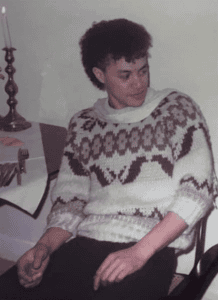
Carroll’s deep love of music, lively personality, and work ethic, sharpened over years in New Zealand’s live music scene, landed him a job as a roadie on U2’s first tour of the country in 1984. He would go on to be U2’s stage manager, then the band’s personal manager, and one of lead singer Bono’s best friends.
Carroll connected U2 to New Zealand, but his untimely death in a motorcycle crash in Dublin in 1986 forged an enduring bond between the band and Aotearoa.
“It was like the death of a close family member,” reflected Bono in his 2022 memoir, Surrender: 40 Songs, One Story.
In a New Zealand TV interview at the time of the first tour, Bono talked about the Who and Jimi Hendrix as “wild dreamers who believed they could change the world through music”. Never shy of grand statements, it led him to ponder how meeting a new person or visiting a new place can change you forever. It turned out to be true. In the two years Carroll was with U2 he became a friend, a manager, a wrangler, and an inspiration. His passing lent U2’s music a new, emotional weight.
“It brought gravitas to the recording of The Joshua Tree,” said Bono in 2009 band biography U2 By U2. “We had to fill the hole in our heart with something very, very large indeed. We loved him so much.”
The Unforgettable Fire
When U2 arrived in New Zealand in 1984 for The Unforgettable Fire Tour, the band’s fourth album of the same name was yet to be released.
Ripping through a setlist similar to live album, Under A Blood Red Sky, released the previous year, the four concerts took in everything from U2’s fiery early anthems I Will Follow and Sunday Bloody Sunday to the haunting and minimal An Cat Dubh off 1980 debut album Boy.
They played New Years Day, a song off 1983’s War that moved them from restless post punk to politically charged anthems. The New Zealand shows also included the debut of Martin Luther King tribute, Pride (In the Name of Love), which would become one of U2’s best and most powerful songs.
It was before the band’s two Auckland shows at the Logan Campbell Centre on September 1 and 2 where Carroll comes into the picture. He spotted the band’s production manager, Steve Iredale, on Auckland’s Karangahape Rd wearing a U2 jacket. Carroll introduced himself, shared his experience of working on the local music scene, and Iredale offered him work at that night’s show.
“Greg was what you might call an outgoing guy,” wrote Kiwi music journalist Colin Hogg in 1986. “He loved life, he loved people and he certainly wasn’t backward in coming forward, when the spirit moved him.”
It was this spirit and enthusiasm, said Hogg, that got him a regular gig with U2.
After impressing with his roadie skills and work ethic at the gig, Carroll was among a group who took the band for a tiki tour of Tāmaki Makaurau up One Tree Hill Maungakiekie.
“Too good for this world”
Carroll’s bond with the U2 whānau was established quickly. He left New Zealand with the band to work on the Australian, European and North American tour dates, and was Dublin-based from mid 1985.
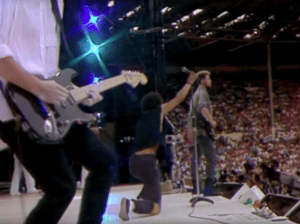
Famously he featured on global TV footage of Live Aid on July 13, 1985, during U2′s slot at Wembley Stadium. Carroll was crouched at the front of the stage threading and managing Bono’s microphone cords during an epic 11-minute version of Bad.
A year later on July 3, Carroll died when a car pulled out in front of him while taking Bono’s motorbike back to his home.
“He was one of those guys you say is too good for this world,” Bono told music magazine Melody Maker in 1987. “We haven’t, and I don’t think we ever will, get over his loss. And he died doing me a favour. I don’t know what to say. It was a terrible time.”
Moe mai rā e hoa
In Surrender, Bono details the band’s decision to take responsibility for bringing Carroll’s body back to New Zealand.
“We decided we should not leave Greg’s body to travel alone on the great distance to his New Zealand home, and so a group of us took him on the long journey to Kai Iwi outside Whanganui,” he wrote.
“Our small community at home was traumatised by the news, but then we had to call Greg’s family in New Zealand and try to explain the unexplainable. It’s impossible to tell someone that somebody they love no longer exists, in this life at least.”
Bono, wife Ali, U2 drummer Larry Mullen Jnr., Steve Iredale, sound engineer Joe O’Herlihy, and other members of the extended U2 family attended his tangi in Whanganui.
“The Māori have a very evolved view of how to bury their dead,” wrote Bono. “Their version of an Irish wake is called a tangi. In a traditional Māori tangi you speak directly with your lost loved one, laugh with them, say sorry for when you let them down. It’s a powerful immersive experience, where you let waves of anger and grief, rage and laughter, break over you.”
In Whanganui, while it was a sad time, U2 being in town was big news with locals seeing Bono and the U2 contingent out and about.
Media liaison officer, Patea Māori Club leader, and Carroll’s uncle, Dalvanius Prime, told local newspaper Whanganui Chronicle: “We have found it very difficult to keep it low key.”
The Chronicle, which was invited to the funeral by Carroll’s parents Tom and Eileen, reported around 200 people attended the service. In a short eulogy Bono paid tribute to his friend: “He believed in New Zealand. He believed in his Māori background. And he believed in New Zealand music. We all believed in him.”
Love comes to Aotearoa
It was Unforgettable Fire and Joshua Tree producer Brian Eno who came up with the “Tahitian or South Seas feel” which would become the foundation of One Tree Hill, wrote Bono in Surrender.
“[The song was named after] the place overlooking Auckland where we had spent such a special time with Greg. The song could carry the grief we could not.”
The Joshua Tree is dedicated to Carroll and, One Tree Hill, with the line “We see the sun go down in your eyes”, written for him.
The album made U2 the biggest band on the planet. For a generation of Kiwi teenagers, U2’s Lovetown Tour was the first time one of “their bands” had reached stadium status on a scale similar to David Bowie or Bob Marley.
As Rip It Up reviewer George Kay noted in his review of the Christchurch show on November 4 at Lancaster Park: “It was U2 that half the teenage population of the South Island had converged on Christchurch to pay homage to.”
Before the shows, the band held a press conference at Auckland Airport covering everything from religion (“All religion has done in our country has divided people, torn the country in two, we’re sick of it,” said Bono) to being famous (“Guinness used to be the biggest export in Ireland, things change,” joked Mullen Jnr).
A question about comparing the Māori and Irish experience in light of a planned New Zealand government celebration of 150 years of British colonisation provoked a cheeky and disbelieving response from Bono: “They’re having a festival to celebrate British colonisation? Now that’s weird. My … well, it wouldn’t be a great party to be in in our country.”
But it was a question about One Tree Hill that offered a touching and sad reflection on the genesis of the song.
“It was the first night we came into New Zealand [in 1984],” said Bono. “I actually couldn’t sleep and I met some people who also couldn’t sleep who were hangin’ in the hotel, and they took me up to One Tree Hill. So, I associate it with the first night. It was the first conversation I had with Greg Carroll … was about One Tree Hill and what it was a symbol of originally for the Maori people. And it’s now … a song.”
Welcome to New Zooland
By 1993 U2 had changed. They were still U2, but following 1988’s patchy Rattle & Hum the band tried something different. Their music took a grittier, more experimental and dancefloor inspired turn, and the Zoo TV live show was ambitious and eye-popping to match.
Even diehard, early-era U2 fans couldn’t fault 1991’s Achtung Baby. The album had it all, from industrial opener Zoo Station and surprise first single, The Fly; to the beauty and power of One; and sing-a-long U2 favourite Mysterious Ways was the first of U2’s “new” anthems to take over the mantel from Pride and New Years Day.
Follow up, 1993’s Zooropa, was equally experimental, and even more fruity with tracks like the Edge-led vocal drone of Numb, Lemon’s serenading psychedelic pop, and the fuzz and groove of Daddy’s Gonna Pay For Your Crashed Car.
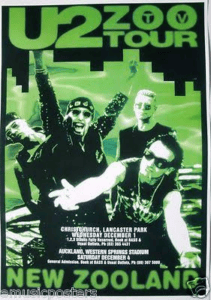
The Zoo TV Tour was a 21 month, 157-date round the world trip. It turned up in New Zealand – dubbed New Zooland – in late 1993 for concerts at Lancaster Park in Christchurch on December 1 and Auckland’s Western Springs December 4.
Designed to induce a sensory overload, the main stage spanned 75m, with a second stage connected by a 50m long ramp reaching into the crowd. The structure was brought to life with four giant video screens, four video walls, 36 video monitors, and 11 Trabant cars suspended above the stage as part of the lighting and video rig.
New Zealand had not seen a show like this before. The NZ Herald’s Russell Baillie opened his review with: “Hear that? It’s the sound of 40,000 or so U2 fans still scratching their heads after the band’s spectacular Zoo TV show at Western Springs.”
During the show, Bono made a phone call to the cheeky Western Springs’ neighbours who had built a make-shift grandstand in their backyard to watch the show for free.
Earlier in the day, support band the 3Ds, who were personally selected by Bono, whipped up a noisy pop racket off the back of the success of their blistering 1992 debut Hellzapoppin. But after the show, they nearly got themselves in trouble with the world’s biggest band when one of their entourage helped themselves to a bottle of wine from U2’s dressing room.
However, the story goes, while the promoter said the 3Ds would not be paid, Bono was having none of it, insisting they get paid double and an extra bottle of wine!
Hello, hello, I’m at a place called Aotearoa
After 13 years, with the extravaganza of Zoo TV a distant memory, the emotional and passionate U2 of old graced the stage for the 2006 Vertigo Tour.
Bono wore an All Blacks’ jersey, a Warriors’ jacket, and changed the lyrics to Beautiful Day to reference Cape Reinga and other Aotearoa-inspired landmarks.
The U2 canon of sing-a-long anthems had expanded too. Alongside Beautiful Day there was Elevation, Vertigo and City of Blinding Lights, with the latter like a new, more polished version of Where the Streets Have No Name.
There was a poignant moment that brought together old U2 with the new, when One Tree Hill gave way to Sometimes You Can’t Make It On Your Own, a beautiful ode to Bono’s late father Bob.
As reviewer Russell Baillie wrote: “It was [a show] which neatly binded the songs of their 21st century albums to their breakthrough days of the 80s, leaving their often confusing, intervening decade largely untouched. That worked a treat, whether it was leaping back in time to early single I Will Follow or causing happy pandemonium during Where The Streets Have No Name.
“For the most part, it was a performance that managed to do the impossible of a stadium show – marry real emotional punch to extravagant gesture.
“The power of this event wasn’t nostalgia,” wrote Baillie, “It was about a band that, as gargantuan as they are, still sounded like they meant it.”
Singing for the “29 lost”
On November 26, 2010, the first words Bono hollers to a sold-out Mt Smart Stadium crowd are a string of Irish-inflected “Kia ora” chants as he skips and struts around the giant “claw” stage of the band’s 360° Tour.
U2 standard, Beautiful Day, kicked off a string of sing-a-long hits – from I Will Follow, to the slick pomp of Mysterious Ways and all-in fist-pumper Elevation.
Yet it was a solemn time in New Zealand, with the Pike River mine disaster claiming the lives of 29 miners just a week earlier.
The band paid tribute to the victims and the people of Greymouth. Bono struggled for words and instead he declared: “In Ireland, we sing.”
I Still Haven’t Found What I’m Looking For led into One Tree Hill which was dedicated to the “29 lost” and as the song played the names of the miners scrolled across the video screen in a touching tribute.
By now U2 had sold more than 150 million records, yet physical music sales continued to plummet because of digital formats and early music streaming. But on the 360° Tour, in support of 2009’s No Line On The Horizon, it was as if U2 was bigger than ever.
At the time, in an interview with the New Zealand Herald, bass player Adam Clayton talked about everything from the All Blacks (“Rugby’s a bit too brutish for me.”) and his love of cricket (“I don’t particularly like the cricket, I like the clothes.”) to his, and the band’s, continued hunger and passion for music.
“Rock ‘n’ roll was invented as a teenage art form,” said the 50-year-old, “and in some ways people diss whether or not you can continue to be relevant as you get older. I would say my experience, and the band’s experience, is that age has nothing to do with it – it’s about the quality of your ideas and how you execute them. I think we’re still very much in the driving seat now.”
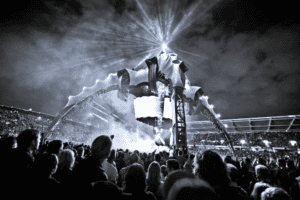
The scale and ambition of the 2010 tour was testament to that. If the Zoo TV Tour was big, then the 360° “in-the-round” show was bigger. Similar to the 1993 tour, The Claw stage was unlike anything to have landed in Aotearoa – it was as if aliens had set up camp in the middle of Mt Smart Stadium.
The towering 50m tall, four-legged steel structure eliminated the need for traditional backdrop screens, giving fans a 360-degree view from anywhere at Mt Smart Stadium.
The giant claws arced out into the crowd, dwarfing the more than 90,000 people who attended over two nights, yet drawing them in, making the set seem immense yet intimate at the same time.
“It’s probably our first stadium tour where we’ve had to learn how to make it work,” said Clayton.
Yet for all the spectacle, the scale of the production never overshadowed the music which is testament to the power of U2’s songs.
The return to One Tree Hill
Once again, Greg Carroll was central to U2’s last visit to New Zealand when the band played The Joshua Tree in full in 2019.
When it was released in 1987, U2 did not tour the album in the southern hemisphere, although the Lovetown Tour included four Joshua Tree tracks.
“It’s great to be here finally after 30 years [to play the album]. I know those songs mean a lot to everyone,” Clayton told Newstalk ZB.
“And obviously being in New Zealand, One Tree Hill, which is about our Kiwi friend who came and worked for us the first time we were here in 1984, and tragically died before The Joshua Tree was released, we will of course be celebrating his life with One Tree Hill.”
A random rant from Bono aside, where, among other things, he told the Kiwi crowd off for their self-doubt and declared himself a megalomaniac, it was a celebration of The Joshua Tree.
“The fans, baying, jumping, and screaming for more, lapped it up, a crowd so passionate it felt at times like this was fan worship at the church of U2,” wrote Chris Schulz in RNZ’s live review.
The show was visually stunning, with a film by Joshua Tree cover designer Anton Corbjin playing throughout the show on a giant 61m wide screen – the biggest ever to be used for a touring concert.
It was also a night of tributes.
For Ultraviolet (Light My Way), the band dug deep into New Zealand’s cultural heritage paying homage to Sophia Hinerangi (better known as Te Paea), a tour guide at the Pink and White Terraces before the eruption of Mt Tarawera in 1886.
Te Paea was one of the most well-known and powerful women in Rotorua during the last half of the 1800s. Her image was projected onto the big screen alongside other influential women, including punk rock “Godmother” Patti Smith and civil rights activist Rosa Parks.
Great great granddaughter, Nadine Pehi, told RNZ that Te Paea was the most amazing storyteller and entertainer. “Being part of performances by one of the world’s greatest rock bands – that would be right up her alley.”
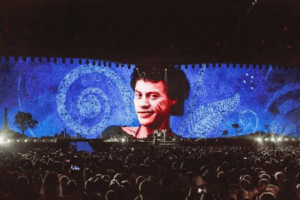
The Joshua Tree set included a heartfelt and emotional One Tree Hill for Carroll, with a cheeky image of the Kiwi projected onto the giant backdrop. Concert closer One was dedicated to the 51 victims of the Christchurch mosque shootings on March 15, 2019.
These touching tributes – to Carroll during the many New Zealand shows they have played, and to the victims of Pike River and the mosque shootings – reveal U2’s unique connection to New Zealand.
It’s a band honouring a country that has been woven into their story since 1984 and remains so today.
Article written by Scott Kara